American Heart Association adds Transcendental Meditation (TM) to its guidelines
The American Heart Association, American College of Cardiology, and American Medical Association released their 2025 guidelines for the treatment of high blood pressure (HBP) in adults.
For the first time in 50 years, national practice guidelines recommend Transcendental Meditation as an evidence-based lifestyle modification to lower blood pressure and prevent cardiovascular events and mortality.
The joint committee concluded that TM has the strongest and most consistent body of scientific evidence among stress-reducing methods for High Blood Pressure. Accordingly, it was the only meditation technique singled out for recommendation. Unlike the 2012 AHA scientific statement on meditation, which was primarily a literature review, this is an official national policy guideline for medical providers.
National practice guidelines recommend Transcendental Meditation as an evidence-based lifestyle modification to lower blood pressure and prevent cardiovascular events and mortality.
Abstract
AIM:
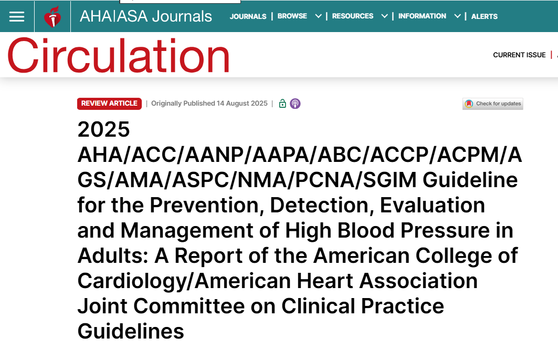
The “2025 AHA/ACC/AANP/AAPA/ABC/ACCP/ACPM/AGS/AMA/ASPC/NMA/PCNA/SGIM Guideline for the Prevention, Detection, Evaluation, and Management of High Blood Pressure in Adults” retires and replaces the “2017 ACC/AHA/AAPA/ABC/ACPM/AGS/APhA/ASH/ASPC/NMA/PCNA Guideline for the Prevention, Detection, Evaluation, and Management of High Blood Pressure in Adults.”
METHODS:
A comprehensive literature search was conducted from December 2023 to June 2024 to identify clinical studies, reviews, and other evidence performed on human subjects that were published since February 2015 in English from MEDLINE (through PubMed), EMBASE, the Cochrane Library, the Agency for Healthcare Research and Quality, and other selected databases relevant to this guideline.
STRUCTURE:
The focus of this clinical practice guideline is to create a living, working document updating current knowledge in the field of high blood pressure aimed at all practicing primary care and specialty clinicians who manage patients with hypertension.
Top Take-Home Messages (refer to the original publication)
The main messages to remember to prevent or treat high blood pressure (hypertension) concern all adults. It is:
1 - modify your lifestyle, in order to; maintain or achieve an ideal health weight (see BMI: Body mass index, here is a BMI calculator), #overweight
2 - follow an heart-healthy diet. This diet called DASH (for Dietary Approaches to Stop Hypertension) privilege the consumption of fruits, vegetables, whole grains, lean proteins and low-fat dairy products, while limiting sodium (salt), added sugars and saturated fats. #dash
3 - reduce sodium intake (table salt), #salt
4 - increase food intake of potassium (pharmacy), #potassium
5 - adopt a program of moderate physical activity, #sport
6 - manage stress (MT), #stress
7 - reduce or eliminate consumption d'alcohol are strongly recommended. #alcohol
Chapter 5. BP Management
5.1. Lifestyle and Psychosocial Approaches
Synopsis
The etiology of primary (previously termed essential) hypertension is a complex interplay of genetics, lifestyle choices, and chronic stress. Even in those with a genetic predisposition to hypertension, healthy lifestyle behaviors can prevent hypertension.
Lifestyle modification approaches are critically important strategies to slow the increase in BP and delay or prevent the onset of hypertension. Once patients have been diagnosed with hypertension, specific lifestyle and nonpharmacological strategies can lower BP, slow progression of BP elevation, reduce the amount of medication needed to control BP, and prevent CVD events and mortality.
A Bayesian network meta-analysis assessed the comparative effectiveness of 22 lifestyle and stressreduction strategies for BP lowering. The DASH eating plan (Dietary Approaches to Stop Hypertension) ranked as the most effective intervention for BP lowering, followed in order by aerobic exercise, isometric resistance training, low-sodium/highpotassium salt interventions, and comprehensive lifestyle interventions. Meditation and breathing control appeared to be the most effective stress-reduction strategies that had at least moderate-quality evidence but were judged to be less effective than lifestyle interventions. It is important to note that BP response to any given intervention will vary across subgroups and individuals and is a function of the fidelity and intensity of the intervention, patient adherence, and in some cases, the starting BP level.
Once patients have been diagnosed with hypertension, specific lifestyle and nonpharmacological strategies can lower BP, slow progression of BP elevation, reduce the amount of medication needed to control BP, and prevent CVD events and mortality.
Recommendation-Specific Supportive Text :
1. In adults who have overweight or obesity (defined as body mass index [BMI] 25.0-29.9 and $30 kg/m2
weight loss : In general, there is a reduction in BP of approximately 1/1 mm Hg (systolic/diastolic) for each 1 kg (2.2 lbs) of weight loss. Evidence consistently demonstrates BP reduction with weight loss regardless of the mechanism.
2. DASH diet or sodium reduction interventions : The DASH eating plan emphasizes fruits, vegetables, low-fat or nonfat dairy, and whole grains, providing high potassium, magnesium, calcium, and fiber intake. It is the most effective eating pattern for lowering BP and has a large and consistent evidence base across BP levels.
3. Interventions that decrease sodium intake reduce BP elevation across the life course, prevent incident hypertension, and lower BP in adults with hypertension. Optimal goal is <2300 mg/day, but aim for an ideal limit of <1500 mg/day.
4. Compared with the use of regular table salt, use of a potassium-enriched salt substitute (in which 100% sodium chloride is partially replaced by potassium chloride and, variably, flavoring agents) causes approximately a 5/1.5 mm Hg (systolic/diastolic) reduction with variability depending on the subgroup and the amount of sodium replacement.
5. Observational studies have consistently demonstrated that individuals with higher dietary intake of potassium-rich foods (from natural sources such as fruits, juices, vegetables, and legumes) and/or a lower urinary sodium to potassium ratio have lower BP levels and lower stroke and mortality rates.
6. Systolic BP and Diastolic BP increase over time with any amount of baseline alcohol intake. Thus, risk for incident hypertension is lowest for those who abstain. Optimal goal is abstinence for all adults for best health outcomes.
7. Increasing leisure-time physical activity reduces BP significantly in adults with hypertension.
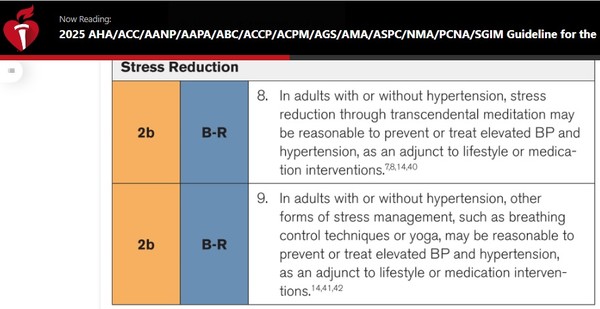
8. A number of stress-reduction strategies have been assessed for their effect on BP lowering. There is consistent moderate to high-level evidence from short-term clinical trials that transcendental meditation can lower BP in patients without and with hypertension, with mean reductions of approximately 5/2 mmHg in SBP/DBP.
9. Among other stress-reducing and mindfulness-based interventions, data are less robust, and evidence is of lower quality because of smaller, short-term trials with heterogenous interventions and results. There is moderate-grade evidence that breathing control interventions lower SBP/DBP by approximately 5/3 mmHg in people with and without hypertension. There is also low to moderate-grade evidence that yoga of diverse types lowers BP.