



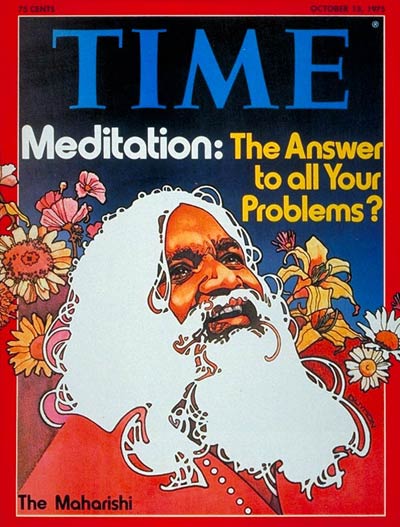
 Maharishi Mahesh Yogi on Mahashivratri - 12 october 1975 Courchevel France
This is India; I am Brahmasmi; I am the totality, I am fullness
Intoduction:
Maharishi Mahesh Yogi emphasized Aham Brahmasmi—“I am Totality”—as a core realization of one’s true nature, aligning with the Vedic principle that the individual self (Atman) is non-different from the universal reality (Brahman).
He taught that this identity transcends the physical, mental, and even cosmic levels: “I am the Self, I am the body, I am the Veda, I am the universe, I am the totality.”
This state of awareness, rooted in silence and pure consciousness, is the foundation of his Transcendental Meditation technique and the vision of a peaceful, unified world.
The phrase Aham Brahmasmi is one of the four Mahāvākyas (Great Sayings) from the Upanishads, specifically from the Brihadaranyaka Upanishad.
It expresses the ultimate truth in Advaita Vedanta: the individual self is not separate from the infinite, unchanging reality of Brahman.
As Maharishi stated, “The Ultimate Reality is that I am Totality, Aham Brahmasmi. And not only I am That, but all this is That—Sarvam Khalvidam Brahma.”
This concept is deeply tied to India’s spiritual heritage, where the Vedic wisdom of non-duality has shaped philosophy, meditation, and culture for millennia.
Maharishi’s mission was to bring this ancient knowledge—especially the Brahmavakya—to the modern world through science-backed meditation, education, and global peace initiatives, asserting that “India’s true identity lies in this timeless knowledge of totality.”
Video transcription:
The world needs a strong Vedic community. The world needs a strong Vedic India, and a strong Vedic India will have a Vedic world. Means, world in terms of total knowledge, in terms of capability of doing everything. That means everyone and everything will be on a level of satisfaction. There'll be no disappointment, there will be no failure, there'll be no wrongs anywhere in one's surrounding. That kind of most ideal. We say today ideal because it's rare, but that is actually the normal situation of life. That is normal life. The other is not yet life. The other is not yet life. The other is not yet life.
That is India: "I am Brahmasmi, I am totality".
Aham purnah I am fullness1
This mantra comes from the Vedic literature. It is a shanti mantra (an invocation to universal peace) and comes from the the Isha Upanishad (or Ishopanishad). These mantras are traditionally recited at the beginning and end of hymns in order to obtain a appeasement.
Devanagari:
ॐ पूर्णमदः पूर्णमिदं पूर्णात् पूर्णमुदच्यते ।
पूर्णस्य पूर्णमादाय पूर्णमेवावशिष्यते ॥
ॐ शान्तिः शान्तिः शान्तिः ॥
Exact transliteration:
Oṃ pūrṇamadaḥ pūrṇamidam pūrṇāt pūrṇamudacyate |
pūrṇasya pūrṇamādāya pūrṇamevāvaśiṣyate ||
Oṃ śāntiḥ śāntiḥ śāntiḥ ||
Here is a suggested translation:
This, the All, is full, complete, perfect, and infinite.
That is also full, whole, and infinite.
From infinity emerges infinity.
Even by subtracting infinity from infinity, infinity remains.
Peace in my heart, peace between us, peace in the universe.
4 Pūrnamadaḥ (पूर्णमदः) refers to "That," the "All," this unmanifested infinite absolute, without object, empty of object, yet full of this satisfied infinite absolute, this silence, this intelligence, creative energy, and this bliss and love (also referred to as "sat chit ananda").
It is this objectless reality that manifests the creation of diversity itself, full and complete [Pūrnam (पूर्णम)].
Pūrnamidam (पूर्णमिदं) Meaning fullness or perfection, it designates "That or this," this manifested, infinite external universe, an eternally changing, provisional world made up of a multitude of objects and differences. It is creation, that which was created from the absolute void of objects but otherwise filled with that absolute.
"पूर्णात् पूर्णमुदच्यते" » pūrṇāt pūrṇamudacyate: From one fullness emerges another fullness, from infinity emerges this other infinity.
The expression “पूर्णस्य पूर्णमादाय पूर्णमेवावशिष्यते" pūrṇasya pūrṇamādāya pūrṇamevāvaśiṣyate: But while creating, the fullness remains full and complete.
5 The fullness, the All, remains intact despite the creation of the relative world. This expression mathematically conveys that perfection never diminishes, just as "infinity is subtracted from infinity, and infinity remains." This is in accordance with physics according to the principle of “conservation of energy66 nothing is lost, nothing is created, everything is transformed - Antoine Laurent de Lavoisier7 .
Transcendental Meditation (TM):
It is possible to to experience this silent and absolute fullness. Through the magic of our human physiology, it is located at the simplest and most silent level of individual consciousness, transcendence, at the source of our thoughts. It is the subject, the inner self. It is this ocean of consciousness which is the intelligence of the universe and blissful love.
Notes & References
1The term Brahman appears in the Rig-Veda as the Supreme Self, the origin of All. In Vedanta, it refers to the consciousness present in all things, to the soul in every being, to the “self (ātman)”, to that transcendent Absolute which is the ultimate principle without beginning or end, without birth or death. Jean Filliozat, The Philosophies of India, PUF, 2012.
2 “Sarvam Khalvidam Brahma” is a Sanskrit phrase from the Chandogya Upanishad that translates as “All this is Brahman.” It contains one of the most liberating and beautiful messages of Indian philosophy. It teaches us that everything around us, the visible as well as the invisible, is a manifestation of ultimate reality. It is the affirmation that the divine is not elsewhere. It is everywhere, in all its diverse forms, and in all living beings: https://upadesham.com/blogs/news/sarvam-khalvidam-brahma-everything-is-divine
3 The Mahāvākyas (महावाक्य) are major aphorisms of the Upanishads. The Mahavakyas describe the essential non-differentiation between the Atman (the individual soul) and Absolute Brahman.
Traditionally, the four principal Mahavakyas are:
- “prajñānam brahma”: “Consciousness is Brahman,” found in the Aitareya Upaniṣad of the Tsag Veda;
- “tat tvam asi”: “You are that,” found in the Chāndogya Upaniṣad of the Sāma Veda;
- “ayam ātmā brahma”: “This soul is Brahman,” found in the Māṇḍūkya Upaniṣad of the Atharva Veda;
- “aham "Brahmāsmi": "I am Brahman," which appears in the Bṛhadāraṇyaka Upaniṣad of the Śukla Yajur Veda.
4 "Purna" is generally translated as "fullness" but it also contains within it the notion of "infinity and perfection".
https://sanskrit.inria.fr/DICO/41.html#puur.na
पूर्ण pūrṇa [pp. pṝ] a. m. n. f. pūrṇā full, filled; filled with
Suggested translation: This is infinite, this is infinite; infinity emanates from infinity; even infinity withdrawn from infinity, infinity remains.
5 (personal note) Here we clearly find the notion of the Immaculate Conception, which was revealed to Bernadette Soubirous directly by the Virgin during the sixteenth apparition, on March 25, 1858, the Feast of the Annunciation. After being pressed by Father Peyramale to ask the Lady's name, Bernadette posed the question to the Virgin. After several smiles, she replied in the Béarnese dialect: “Que soy era Immaculada Councepciou” (I am the Immaculate Conception). By saying “I am” and not “I was,” Mary indicates that this is her identity; she is not only conceived immaculate, but she is the Immaculate Conception. In short, she says, I am the one who creates this universe without being affected by it, I am the creator. Isn't that the very definition of God?
N.B.: God has no gender, but if one wants to attribute one to him, then it should be feminine, because it is woman who conceives and gives birth.
6Energy Conservation: Understand this fundamental principle of physics that governs everything:energy conservation explained
7Antoine Lavoisier. Elementary Treatise on Chemistry; pp. 140–141; Cuchet Publishers; Paris 1789 https://gallica.bnf.fr/ark:/12148/btv1b8615746s/f200
#maharishi #vedic #meditation #wholeness #india #knowledge #satisfaction #maharishimaheshyogi #sanatanadharma #hinduism
His Holiness Maharishi Mahesh Yogi is recognized as one of the foremost scientists in the field of consciousness in modern times. He is the founder of the Transcendental Meditation technique and is also responsible for reviving the knowledge of consciousness enshrined in AyurVeda, StapathyaVeda, Jyotish, ...